Accreditation Eligibility and scope inquiries are accepted year-round. Begin with a no-fee eligibility and scope review. Start Free Eligibility Review · Current program status
Eligibility reviews open year-round · No fee Verify AccreditationContactMy CHSPS
CHSPS — Commission for Health, Safety & Professional Standards
Specialty accreditation pathway · CHSPS-AIG

AI Governance & Assurance Accreditation

At a glance

Total to get accredited
$5,500all-in; includes the $1,250 application fee
Every year after
$1,500annual accreditation fee
Eligibility answer
10 business dayswritten-outcome target after a complete inquiry
Accreditation term
3 years

Eligibility review is free. You pay nothing until eligibility is confirmed and an agreement is signed.

For health systems, life sciences and other organizations that build or rely on consequential AI — independent review of accountability, validation, human oversight, monitoring and lifecycle change.

501(c)(3) nonprofit · Standards published · Independent decision · Publicly verifiable
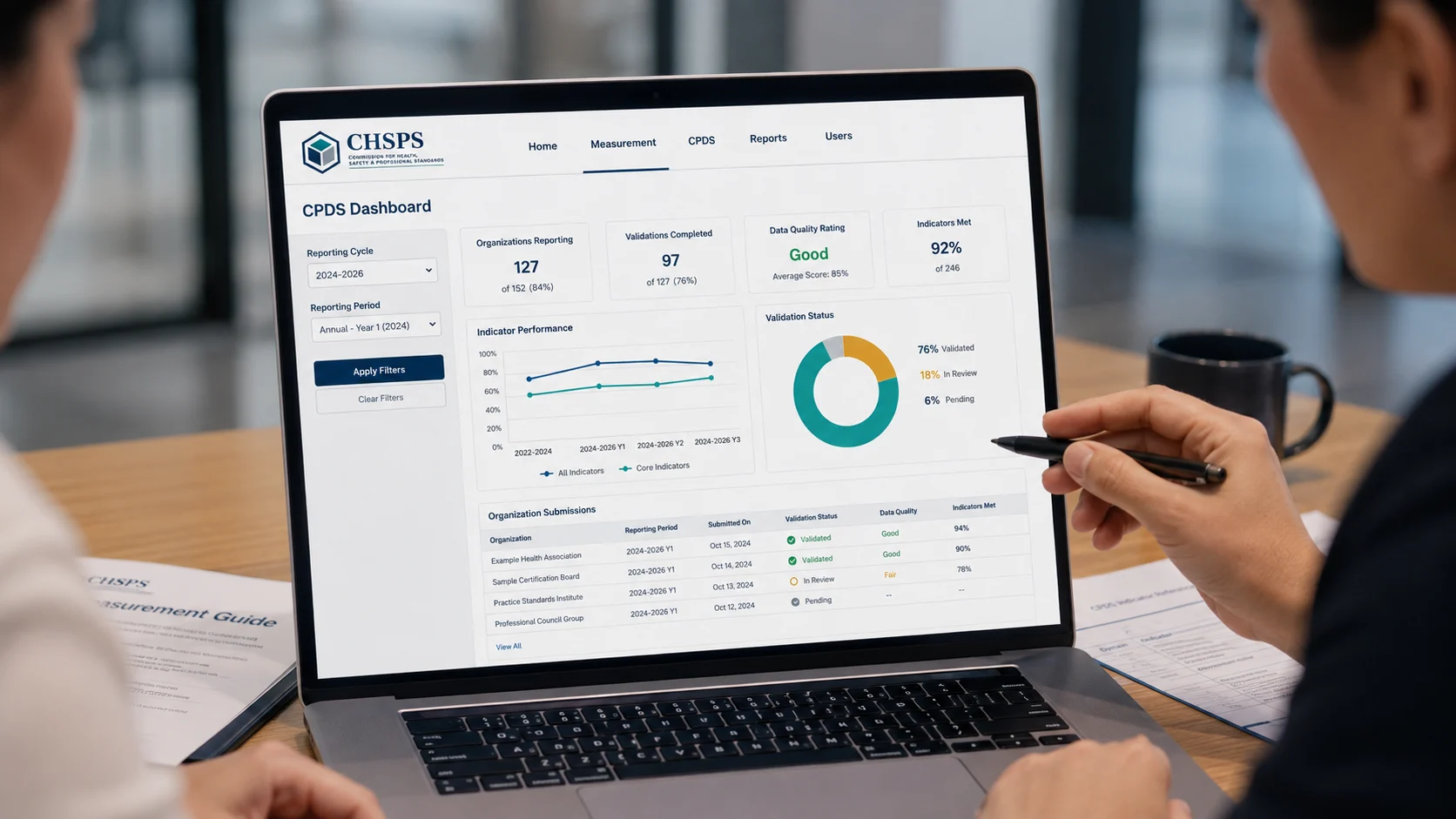
Governance team reviewing AI performance, risk and assurance evidence
Fit and next steps

Who it’s for, and how it works

A good fit

  • Health systems, life sciences and pharmacy organizations using consequential AI
  • Organizations that develop, provide, deploy or operate AI
  • Credentialing and education organizations with high-responsibility AI

Not the right fit

  1. Free eligibility reviewAbout 5 minutes to submit. CHSPS sends a written outcome, targeted within 10 business days after a complete inquiry.
  2. Scope & agreementCHSPS confirms the scope in writing. You sign the applicant agreement and pay the $1,250 application fee, credited toward the $5,500 total.
  3. Evidence & technical reviewYou submit evidence and the $4,250 review balance. Conflict-screened reviewers evaluate it, and you can answer any findings.
  4. Independent decisionA separate committee makes the decision, and accredited scope becomes publicly verifiable. The review timeline is stated in writing at scope confirmation, before you pay anything.
Step 1 · Find the right pathway

Is AIG the accreditation you actually need?

AIG evaluates the organization-level governance and assurance system for consequential AI. Other CHSPS pathways address narrower AI contexts.

Health systemsLife sciencesPharmacyCredentialingEducationHigh-responsibility enterprise AI
Organization-wide consequential AI governance

Inventory, risk, validation, human oversight, monitoring, vendors, incidents and lifecycle control.

AIG
High-stakes assessment integrity

Integrity system surrounding consequential examinations and assessment decisions.

HSAI
Remote examination administration

Remote proctoring, identity, administration, technology and AI-assisted monitoring.

REA
Learner-facing AI

AI tutors, feedback, instructional support and assessment-boundary controls.

ALT
Step 2 · Define the accredited scope

One AIG accreditation. A role profile and scope that match your responsibilities.

Public verification identifies the entity, role profile, covered AI systems or use categories, sites or services, and explicit exclusions.

What is accredited

AI governance & assurance system

The organizational system used to control consequential AI within the approved scope.

What may be included

Defined AI uses and operations

Named systems, use categories, consequential functions, business units, services and sites.

What is outside scope

No blanket product or company claim

Individual practitioners, every AI product automatically, unrelated uses, or activity outside the approved scope.

Current standard

CORE-100 + AIG-610

Edition 2026.1 · continuous eligibility intake · 3-year accreditation term.

Developer & Provider profile

Evidence follows the product and model lifecycle.

Expect deeper review of design controls, data governance, validation, release criteria, model/version traceability, customer limitations, monitoring commitments, incident handling and material change.

Step 3 · Technical review

12 assurance domains cover the consequential-AI lifecycle.

Reviewers test documented controls against operating evidence, records, demonstrations, interviews and lifecycle tracers.

01Assurance domain

Governance & accountability

Authority, owners, competence, decision rights and management review.

02Assurance domain

AI inventory & classification

System, vendor, version, intended use, owner, affected population, impact, risk and monitoring.

03Assurance domain

Intended use & boundaries

Purpose, users, limitations, unsupported uses and approval boundaries.

04Assurance domain

Data governance

Provenance, quality, representativeness, access, privacy and lineage.

05Assurance domain

Risk & impact assessment

Pre-use and change-triggered analysis of foreseeable harm and residual risk.

06Assurance domain

Validation & fitness for use

Acceptance criteria, relevant test conditions, results, limitations and revalidation.

07Assurance domain

Human oversight

Qualified review, authority to challenge, override or stop, escalation and automation-bias controls.

08Assurance domain

Fairness & affected parties

Bias and fairness evaluation, access, complaint signals and remediation proportionate to risk.

09Assurance domain

Transparency & traceability

Records sufficient to reconstruct versions, approvals, decisions and human actions.

10Assurance domain

Third-party AI & vendors

Due diligence, contracts, evidence access, change and incident notice, and continuity.

11Assurance domain

Monitoring, incidents & CAPA

Performance and drift signals, incident response, root cause, corrective action and effectiveness.

12Assurance domain

Change, release & retirement

Material-change review, revalidation, rollback, release, retirement and preserved history.

Operational audit

Review follows AI through real lifecycle decisions.

The evidence record is tested end to end, not as a policy-only exercise.

Lifecycle tracer: inventory → classification → intended use → validation → approval → deployment → monitoring → material change.
Incident tracer: signal → investigation → containment → root cause → CAPA → effectiveness review.
Vendor tracer: due diligence → evidence access → contract controls → change notice → monitoring → continuity.
Material-change tracer: new model/version/data/use → impact assessment → revalidation → approval → rollout or rollback.
Step 4 · Eligibility & fees

Confirm readiness before you pay an application fee.

The first eligibility and scope review is free. Formal fees begin only after CHSPS confirms the proposed scope and the agreement is signed.

✓
Accountable organizationA legal entity or defined business unit owns the AI governance system.
✓
Defined consequential-AI scopeSystems, roles, use categories, services/sites and exclusions can be identified.
✓
Operational governanceThe governance framework is implemented, not merely planned.
✓
Reviewable lifecycle evidenceInventory, risk, validation, oversight, vendors, monitoring, incidents and change records exist.

Published specialty fee flow

Eligibility$0

Fit and preliminary scope confirmation.

Application$1,250

After confirmed scope and signed agreement.

Evidence submission$4,250

Balance when the formal evidence package is submitted.

Total initial specialty review$5,500
You do not pay $5,500 upfront.
Term3 years
Annual$1,500
Renewal$3,500
Concurrent added specialty$2,750

View the controlled specialty fee schedule →

Step 5 · Accreditation process

One seven-stage CHSPS process.

AIG uses the same institutional accreditation pathway as every CHSPS program, with AI-specific evidence and tracers.

  1. 01Free Eligibility Review

    Confirm pathway fit, role profile and proposed scope.

  2. 02Scope & Agreement

    Finalize covered entity, AI systems/use categories, services/sites, exclusions and fees.

  3. 03Self-Study & Evidence

    Map CORE-100 and AIG-610 to inventory, risk, validation, oversight, monitoring and lifecycle evidence.

  4. 04Technical Review

    Review documents, records, samples, interviews, demonstrations and lifecycle tracers.

  5. 05Findings & Corrective Action

    Address requirement-linked findings with objective evidence and effectiveness checks.

  6. 06Independent Decision

    Decision-makers separate from technical review evaluate the complete record.

  7. 07Public Verification & Maintenance

    Approved scope is published and then maintained through annual reporting, material-change duties and renewal.

Step 6 · Organizational value

What AIG accreditation gives stakeholders.

01

Independent AI governance assurance

External evaluation beyond an organization's own responsible-AI declarations.

02

Lifecycle control

Governance from inventory and validation through monitoring, change and retirement.

03

Human accountability

Evidence that consequential use remains subject to defined human authority, challenge and escalation.

04

Publicly verifiable scope

Stakeholders can verify exactly which organization, role and AI scope CHSPS reviewed.

Before you decide

Use AIG when the governance system itself is the assurance target.

Use HSAI for consequential assessment integrity, REA for remote examination administration, and ALT for learner-facing AI. AIG is the organization-level AI governance pathway.

Step 7 · After accreditation

Maintaining AIG accreditation

AI systems change quickly. Accredited governance must remain current, traceable and effective throughout the term.

Annual cycle

Keep the AI assurance record current

  • AI inventory and risk-profile changes
  • validation and monitoring status
  • performance and drift signals
  • human-oversight activity
  • incidents, CAPA and effectiveness
  • critical vendor and dependency changes
Material changes

Report changes that could affect conformity

  • new consequential models or systems
  • major model/version/data changes
  • expanded intended use or affected population
  • new sites, services or consequential functions
  • vendor/platform changes
  • automation or human-oversight changes
Renewal

Revalidate the living governance system

  • governance and inventory
  • risk and intended-use controls
  • validation and human oversight
  • fairness, transparency and vendors
  • monitoring, incidents and CAPA
  • change, release and retirement evidence
Accreditation term3 years
Annual fee$1,500
Renewal review$3,500
Renewal timingWorkspace 9 months before expiration

Target renewal submission: 6 months before expiration. A new product, site or AI use is not automatically within accredited scope.

Optional applicant support

Preparation and evidence tools stay separate from accreditation decisions.

Optional preparation & evidence toolkitExpand ↓
1 · Confirm scope
Entity, role, AI systems/use categories, sites and exclusions.
2 · Build the inventory
Owner, version, intended use, impact, oversight, validation and monitoring.
3 · Map governance & risk
Accountability and risk/impact assessment.
4 · Validate before reliance
Acceptance criteria and fitness-for-use evidence.
5 · Operationalize oversight
Human intervention, escalation and records.
6 · Control lifecycle change
Monitoring, vendors, incidents, rollback and retirement.
7 · Run readiness review
Map evidence, sample operations, close gaps and document leadership review.
Guide

Applicant Preparation Guide

Step-by-step evidence map and pre-submission checklist.

Download guide →
Toolkit

Editable evidence tools

Inventory, risk, validation, monitoring, incident/CAPA and vendor templates.

Open toolkit →
Preparation center

Evidence examples & common gaps

Walk through AIG-610 readiness without pre-approval of evidence.

Open preparation center →

Impartiality safeguard: preparation materials explain requirements and provide general tools. They do not pre-approve evidence, guarantee an outcome or influence accreditation decision-makers.

Published standard · Edition 2026.1

CHSPS-AIG-610

Normative AIG requirements, role applicability and evidence expectations are controlled in the published specialty standard and used with CHSPS-CORE-100.

Download AIG-610
Before you apply

Questions buyers ask first

What does it cost, all-in?

$5,500 for the initial specialty review: the $1,250 application fee when you sign the applicant agreement, then the $4,250 review balance when you submit evidence. After that, $1,500 a year and a $3,500 renewal review every 3 years. A concurrent additional specialty scope in the same organization is $2,750. The eligibility review is free.

How long does it take?

The free eligibility review targets a written outcome within 10 business days after a complete inquiry. CHSPS does not publish a single planning target for this pathway; the review timeline is stated in writing at scope confirmation, before you pay anything.

What do we need to start, and what evidence comes later?

Nothing to upload. Step 1 asks only for your name, email and organization; the rest of the form covers scope, operating status and readiness, in about 5 minutes. Formal evidence comes after the agreement is signed: AI inventory, risk, validation, human oversight, monitoring and lifecycle evidence.

Can organizations outside the United States apply?

Yes. CHSPS is a United States–based 501(c)(3) nonprofit; organizations in any country may apply.

What if we are not eligible?

Every eligibility review ends in a written outcome: Eligible, Potentially Eligible — Additional Information Required, or Not Eligible, with the specific thresholds not yet met. There is no charge for the review, and if a different CHSPS pathway fits better, the review says so.

Does accreditation cover every AI tool we use?

No. Only AI systems, use categories, functions, sites or services explicitly included in the approved scope are represented as accredited.

Ready when you are

Start with a free AIG eligibility review.

Tell us what consequential AI your organization develops, provides, deploys or relies on. We will confirm pathway fit, role profile and proposed scope in writing before application fees begin.

CHSPS is an independent accreditor. CHSPS is a United States–based 501(c)(3) nonprofit; organizations in any country may apply.